
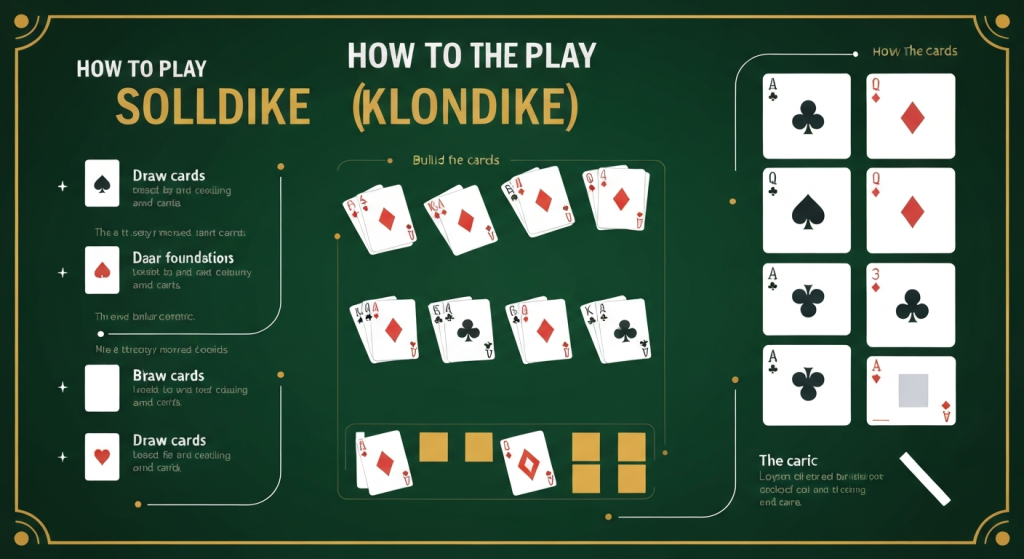
Solitaire — specifically Klondike, the version Windows made famous — is the card game almost everyone has played and most people half-know. Learn the layout and a handful of rules and you’ll be playing in five minutes; learn the strategy and you’ll actually start winning. Here’s the complete how-to.
What Is Klondike Solitaire?
Klondike is a single-player game played with one standard 52-card deck (no jokers). In the US and Canada “Solitaire” almost always means Klondike; in the UK it’s often called Patience. The goal is to build four foundation piles, one per suit, in ascending order from Ace up to King.
The Layout
The table has four areas:
- Tableau — seven columns dealt left to right, the first with 1 card up to the seventh with 7 cards (28 total). Only the top card of each column is face up; the rest are face down.
- Stock — the remaining 24 cards, face down, top-left.
- Waste — where cards you draw from the stock go.
- Foundations — the four empty spots, top-right, where you build each suit Ace→King.
The Rules
- Build the tableau down in alternating colours. A black 5 goes on a red 6, a red 4 on a black 5, and so on.
- Move sequences as a unit. A properly ordered run (e.g. black 9, red 8, black 7) can be moved together onto a red 10.
- Foundations go up by suit. Start each with its Ace, then 2, 3… to King. Only one suit per foundation.
- Only a King (or a King-led sequence) fills an empty column.
- Draw from the stock when you’re stuck — one card at a time (Turn 1) or three at a time (Turn 3), where only the top of the three is playable.
- Reveal a face-down tableau card by clearing the face-up card on top of it.
How a Game Flows
- Scan the board — play any visible Aces (then 2s) straight to the foundations.
- Make tableau moves that reveal face-down cards, prioritising the column with the most hidden cards.
- Use the stock/waste to keep moves going when the tableau stalls.
- Free up empty columns and fill them with Kings to unlock more space.
- Keep building foundations until all 52 cards are home — that’s a win.
Turn 1 vs Turn 3
Turn 1 deals one stock card at a time and is far more winnable — roughly a 33% win rate with good play. Turn 3 deals three at a time (only the top playable) and is much harder, winning around 11% of the time. Beginners should start with Turn 1.
Winning Strategy
- Flip the first stock card before any other move — it widens your options from the start.
- Always play Aces and 2s up immediately; they’re never useful in the tableau.
- Don’t rush other cards to the foundation. Keep them in play as long as both the next-lower opposite-colour cards are still available — sending them up too early can block tableau moves.
- Expose the deepest pile. Given a choice, uncover the column hiding the most face-down cards.
- Don’t empty a column unless you have a King ready to fill it — and pick the King colour that keeps your sequence going.
- In Turn 3, memorise the deck order and use unlimited undo in digital versions to test lines.
Like quick card-game rules explainers? See our guides to 3 Card Poker rules and the royal flush.
Frequently Asked Questions
Is every game of Solitaire winnable?
No. Some deals are unsolvable, and even solvable ones can be lost without knowing the face-down cards — which is why win rates aren’t 100%.
What fills an empty tableau column?
Only a King, or a sequence starting with a King.
Turn 1 or Turn 3 — which should I play?
Turn 1 for a much higher win rate (~33%); Turn 3 for a tougher challenge (~11%).
Why is it called Klondike?
The name is usually linked to the 1890s Klondike Gold Rush, though there’s no firm evidence. In the UK the same game is known as Patience.