
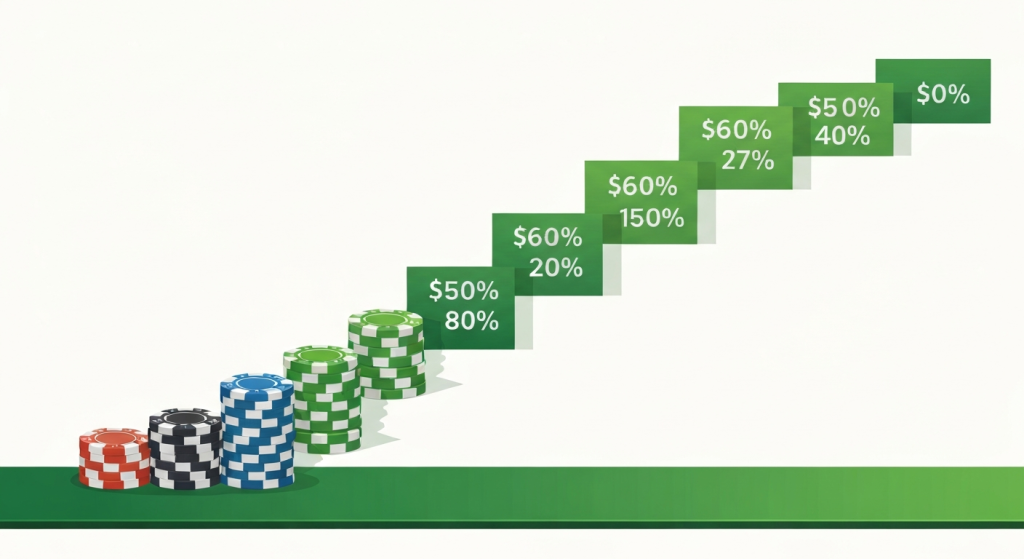
You have battled through a poker tournament, played well, and reached the final table. Then a hand comes up where the correct play is not what a cash-game player would do at all — because in a tournament, the chips in front of you are not worth their face value. Understanding why is the single biggest leap most players make in tournament poker, and it has a name: ICM, the Independent Chip Model.
What ICM is
The Independent Chip Model is a mathematical formula used to convert your tournament chip stack into its real-money value — your share of the prize pool. It answers a deceptively tricky question: given the chip stacks at the table and the payout structure, how much actual money is my stack worth right now? Because tournament prizes are paid in fixed amounts to a limited number of places, chips and dollars are not the same thing.
Why tournament chips aren’t worth their face value
In a cash game, a $100 stack is worth exactly $100 — you can cash out any time. Tournaments are different because of the payout structure. Prizes are top-heavy and fixed, so the value of each chip changes depending on the situation. The crucial principle is that chips have diminishing value: doubling your stack does not double your equity in the prize pool.
Consider a simple example. If you have 10,000 chips and win another 10,000, you now have 20,000 chips — but you have not doubled your money, because the extra chips are worth less to you than your first ones were. Meanwhile, the chips you could lose are worth more, because busting out means winning nothing. This asymmetry is the heart of ICM.
How ICM changes your decisions
ICM has profound effects on strategy, especially near the money bubble and at the final table:
- Play tighter when short stacks are about to bust: on the bubble, surviving into the money can be worth more than accumulating chips, so you avoid marginal spots that risk your tournament life.
- Pressure medium stacks: big stacks can bully mid-sized stacks who cannot afford to call, because those players have the most to lose in dollar terms.
- Reconsider ‘correct’ calls: a call that is profitable in chips can be losing in real money once ICM is applied.
In short, ICM tells you that not all profitable-in-chips decisions are profitable in cash — and survival has a value all its own.
The bubble: where ICM bites hardest
The money bubble — the point just before players start getting paid — is where ICM pressure peaks. Here, folding hands you would happily play in a cash game is often correct, because busting out with nothing is catastrophic when one more elimination guarantees you a payout. Big stacks exploit this by applying relentless pressure, knowing shorter stacks are desperate to survive. Recognising and using bubble dynamics is a hallmark of a strong tournament player.
The limits of ICM
ICM is a powerful guide, but it is not the whole story. It assumes all players are equally skilled and ignores factors like your edge over weaker opponents, future position, and blind pressure. A very skilled player might correctly take a slightly “-ICM” spot to accumulate chips they can use to win the whole event. Treat ICM as an essential framework, not an unbreakable law — it informs your decisions rather than dictating them.
The bottom line
ICM is the model that translates tournament chips into real money, revealing that chips lose value as you accumulate them and that survival is worth protecting. It reshapes correct play on the bubble and at the final table, encouraging caution when busting is costly and aggression when you can pressure others. Master the intuition behind ICM — that dollars, not chips, are what you are really playing for — and your tournament results will improve dramatically.