
If you have spent time around serious poker players lately, you have heard the term thrown around constantly: GTO. Game Theory Optimal play has reshaped how modern poker is understood and taught, and it can sound intimidatingly mathematical. But the core idea is elegant and approachable. Here is what GTO poker strategy actually means and how to use it.
What GTO means
GTO stands for Game Theory Optimal. It is a style of play based on mathematical game theory that aims to make you unexploitable — meaning no matter what your opponents do, they cannot gain an edge against you over the long run. A GTO strategy is a perfectly balanced approach where your bets, raises, and folds are mixed in precise proportions so that opponents can never find a profitable counter-strategy. In theory, if you played perfect GTO, the worst you could do against anyone is break even, and you would profit against anyone who makes a mistake.
The idea of balance
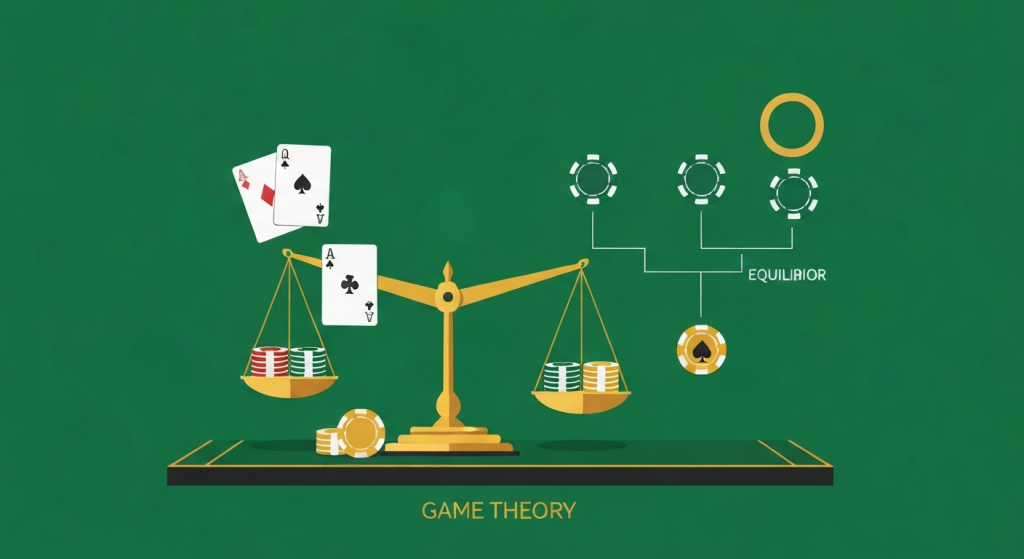
At the heart of GTO is balance. Imagine you only ever bet big when you had a strong hand. Observant opponents would quickly notice and simply fold whenever you bet, giving you no value. GTO fixes this by ensuring your betting ranges are balanced — for every value bet you make, you also make a calculated number of bluffs, in the correct ratio. Because your strong hands and bluffs are mixed together in the right proportions, opponents cannot tell them apart and cannot exploit you. Balance across all your actions is what makes you unreadable.
Key GTO concepts
A few building blocks come up again and again:
- Ranges, not hands: GTO thinks in terms of the entire range of hands you could hold in a spot, not a single hand.
- Balanced bluff-to-value ratios: the correct mix of bluffs and value bets, often tied to the size of your bet relative to the pot.
- Mixed strategies: sometimes the optimal play is to take one action a certain percentage of the time and another action the rest, rather than always doing the same thing.
- Minimum defence frequency: how often you must continue against a bet to avoid being exploited by bluffs.
GTO vs exploitative play
It is important to understand that GTO is not the only way to win — and often not the most profitable. The opposite approach is exploitative play, where you deliberately deviate from balance to punish a specific opponent’s weaknesses. If a player folds far too often, the exploitative move is to bluff them relentlessly, even though that is not GTO. GTO is a defensive baseline that guarantees you cannot be exploited; exploitative play sacrifices that safety to win more against flawed opponents. The strongest players use GTO as their foundation and then deviate to exploit when they spot a clear weakness.
Why GTO matters
GTO has become essential at higher stakes, where opponents are skilled enough to punish any predictable, unbalanced tendency. Against tough, observant players, a balanced GTO-based game protects you from being read and exploited. It also gives you a rigorous framework for studying poker — solvers, the software that computes GTO solutions, have revealed optimal strategies that players now train against to sharpen their instincts.
Should beginners study GTO?
For newer players, there is a practical truth: at lower stakes, opponents make so many obvious mistakes that straightforward exploitative play — value betting your strong hands and bluffing predictable folders — earns more than perfect balance. You do not need flawless GTO to beat a table of loose recreational players. That said, learning GTO concepts like ranges, balance, and bluff-to-value ratios will deepen your understanding and prepare you for tougher games. Think of GTO as the theory that makes you fundamentally sound, and exploitation as how you maximise profit against real, imperfect humans.
The bottom line
GTO poker strategy is a mathematically balanced, unexploitable way of playing that mixes value bets and bluffs in precise ratios so opponents can never gain an edge. It is the defensive foundation of elite play, best combined with exploitative adjustments against weaker opponents. You do not need to master it to win at low stakes, but understanding its core ideas — ranges, balance, and mixed strategies — will make you a far more complete and dangerous player.