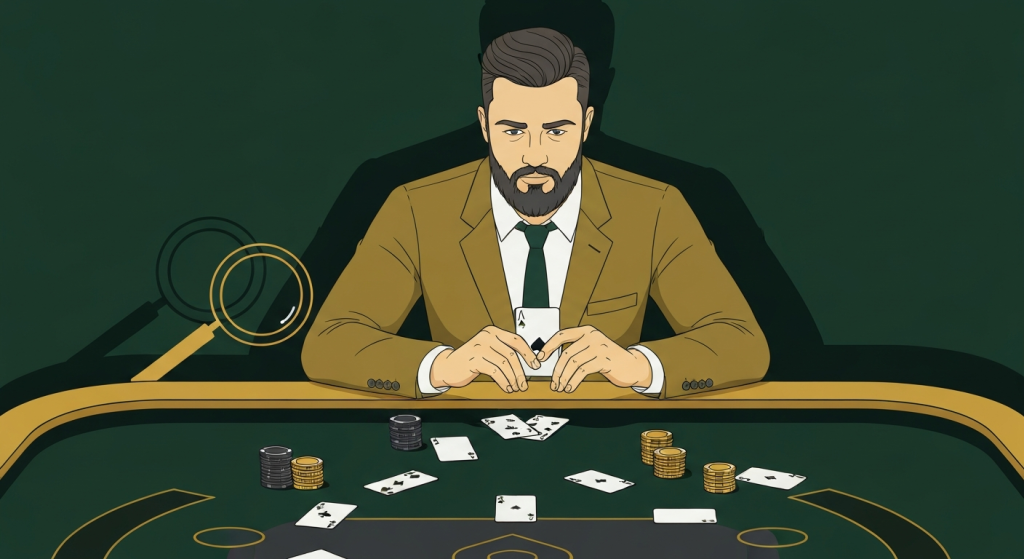
A poker tell is an unconscious physical action, verbal cue, or betting pattern that leaks information about a player’s hand strength or intentions. Reading opponents’ tells — and controlling your own — is a genuine part of the live-poker edge, though tells are supplementary to solid strategy, not a replacement for it.
Understanding Tells
A tell is any behavior that reveals information a player would rather hide. It stems from the pressure of the game: the excitement of a big hand or the anxiety of a bluff. Tells are usually subtle and fleeting — far from the movie clichés — and only useful when interpreted in context: the player’s style, the board, stack sizes, and the situation.
Physical Tells
- Shaking hands: often a genuine adrenaline response to a very strong hand rather than nerves from bluffing.
- Chip handling: confident, relaxed chip play can signal strength; timid, hesitant pushing can signal weakness.
- Posture and demeanor: leaning back and relaxed can mean comfort (a big hand); rigid, aggressive posturing can mean a bluff.
- Eyes and breathing: quick glances at chips after the flop, or shallow breathing, can betray interest or tension.
- Freezing vs relaxing: sudden stillness often means the player is controlling a strong or very weak hand.
“Weak Means Strong, Strong Means Weak”
The classic maxim: players often project the opposite of the truth. Acting disinterested or sighing while betting frequently disguises a monster; acting loud and confident often masks a weak hand. It’s a useful starting point, not a law.
Timing Tells
- Fast bet/call: can mean an eager strong hand, or a bluff projecting confidence; a quick call can be a marginal “I don’t want to think about it” hand.
- Long tank: a genuinely tough decision — or a strong hand faking one to induce a call.
- Instant check (online): almost always weakness; the player has given up on the pot.
Verbal Tells and Table Talk
What players say can leak information. Complaining about a bad run can precede a strong hand; over-talking to distract you can accompany a bluff; needling (“you really shouldn’t call”) is often a bluff. As with physical tells, weak-means-strong frequently applies.
Betting-Pattern Tells — The Most Reliable
Betting patterns are the most consistent and are available both live and online, because they’re less conscious and observable over many hands:
- Consistent sizing tendencies (big with value, small with bluffs — or the reverse).
- Street-by-street sizing changes that reveal draws hitting.
- Check-raising only with monsters, or habitual donk-betting with weak draws.
Reading patterns pairs naturally with the maths: once you’ve narrowed a range, use pot odds to decide whether calling is profitable, and lean on your knowledge of starting-hand ranges to interpret what an opponent likely holds.
Reliability Caveats
- Probabilistic, not certain: a tell shifts odds; it doesn’t guarantee a hand.
- Players fake tells: experienced opponents use reverse tells deliberately.
- Context is king: the same tell means different things from an amateur versus a pro.
Online “Tells”
The visual layer is gone, but behavior remains — and often becomes clearer:
- Bet timing: snap actions and long tanks read strongly.
- Bet sizing: deviations from a player’s standard size are telling.
- Auto-actions: instant check/fold shows no interest; instant check/call can mean marginal showdown value.
- Chat: boasting or trying to distract can leak intent.
Avoiding Your Own Tells
- Build a consistent routine — same pace, same chip handling, neutral expression.
- Act the same regardless of hand strength.
- Vary your timing so snap decisions don’t give you away.
Where Tells Fit in Strategy
Tells are the icing, not the cake. The foundation is hand ranges, pot odds, position and stack-to-pot ratio. Tells help narrow ranges and tip close decisions — but relying on them without fundamentals is a losing approach.
Common Tells and Interpretations
| Tell | Common (weak-means-strong) read | Reliability |
|---|---|---|
| Shaking hands on a big bet | Adrenaline from a strong hand | Moderate–high |
| Over-acting / staring down | Projecting strength — often a bluff | High |
| Sighing, looking away while betting | Faking weakness — often very strong | High |
| Instant check (online) | Weakness, no interest | Very high |
| Bet sizing deviation | Specific strength/weakness or bluff | High |
Frequently Asked Questions
Are tells more important than fundamentals?
No. Ranges, pot odds, and position win in the long run. Tells fine-tune decisions but never override sound strategy.
How do I practice reading tells?
Play live and focus on one opponent and one behavior at a time. Take notes, watch how players act on known hands, and factor in their experience level.
Can I fake tells to mislead opponents?
Yes — reverse tells (acting weak with a monster) work, but only against observant opponents, and consistency is essential to be believable.
What’s the biggest mistake with tells?
Over-relying on a single tell out of context. Always combine it with betting history, board texture, and stack sizes.
Bottom line: A tell is information leaked by behavior or betting. Betting-pattern tells are the most reliable, physical tells the most overrated — use them to support strong fundamentals, not replace them.